

The Buzz About WALS®: How One Strategy is Making a Big Impact on Public Health

Mosquitoes are one of the most dangerous insects in the world, responsible for spreading deadly diseases like malaria, dengue fever, and Zika virus. Two of the most notorious mosquito species are Aedes aegypti and Aedes albopictus, also known as the yellow fever mosquito and Asian tiger mosquito, respectively. These species have earned a reputation as some of the most difficult mosquitoes to control, thanks to their ability to breed in small pools of water and their resistance to many insecticides.
Did you know?
Did you know that Aedes aegypti and Aedes albopictus are also fascinating creatures? For example, Aedes aegypti is believed to have originated in Africa but is now found in tropical and subtropical regions worldwide. This mosquito is particularly attracted to human hosts and is responsible for transmitting viruses such as yellow fever, dengue fever, and chikungunya. Aedes albopictus, on the other hand, is native to Southeast Asia but has now spread to all continents except Antarctica. This mosquito is a known vector of dengue fever and chikungunya and is also a potential vector of Zika virus.
More fun facts!
- Aedes aegypti has a unique way of feeding on blood. Unlike other mosquito species that bite multiple hosts to get enough blood for egg production, Aedes aegypti will feed on a single host until it has enough blood for its entire reproductive cycle.
- Aedes albopictus is known for its aggressive and persistent biting behavior. In fact, it has been nicknamed the “ankle biter” because it tends to bite people on the lower parts of their bodies, such as the ankles and feet.
- Aedes aegypti is believed to be responsible for the deaths of more humans than any other animal. This is due to its ability to transmit several deadly diseases, including yellow fever, dengue fever, and Zika virus.
- Aedes albopictus is a relatively new species in North America, having first been detected in Texas in 1985. Since then, it has spread rapidly and is now found in many parts of the United States.

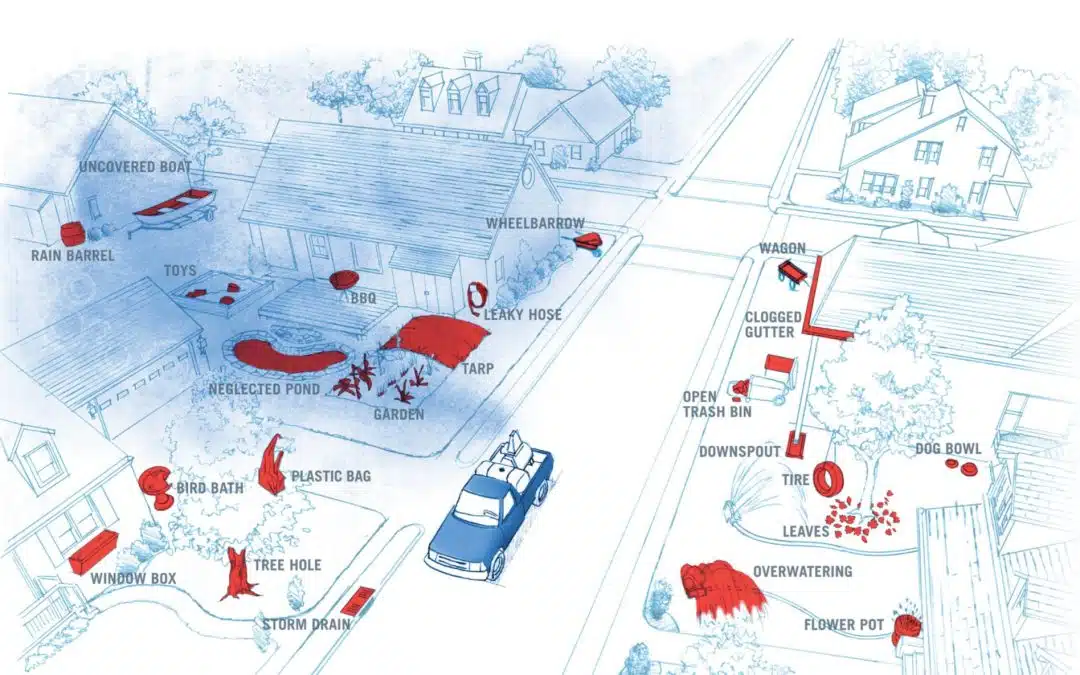
Both Aedes aegypti and Aedes albopictus have adapted well to urban environments, where they can find plenty of breeding sites in things like flowerpots, discarded tires, and even bottle caps.
Despite their interesting characteristics, Aedes aegypti and Aedes albopictus are dangerous insects that can cause serious harm. That’s why it’s important to take action to control their populations. One effective method for controlling these mosquitoes is the use of larvicides, products that kill mosquito larvae before they can mature into adults. Using a backpack, a truck-mounted blower, or an aircraft to disperse the larvicide can be particularly effective because it can reach difficult-to-find breeding sites and can cover a large area quickly.
How to target container breeding mosquitoes? The WALS Application Strategy
After over two decades of research, Valent BioSciences partnered with public health organizations to bring you the most target-specific biorational solution out there. The WALS® approach is the ultimate mosquito-fighting strategy! Using advanced technology and specialized equipment, you can deliver the most effective and specific biorational larvicide, VectoBac® WDG (Bti strain AM65-52), straight to the larvae in difficult-to-reach habitats.

More Info on WALS Here: WALS® – Valent BioSciences – Public Health
WALS® incorporates a layered approach to manage vector populations by considering the difficulty of finding/accessing larval mosquito habitats, the mosquito vectors, and the application strategy. Container mosquito species can spread diseases like Zika virus, West Nile virus, and dengue fever by inhabiting small or hidden containers. The WALS® strategy can be executed using equipment such as backpack sprayers, vehicle-mounted sprayers, and aircraft to treat these habitats effectively. The WALS strategy is biorational, non-toxic, and can cover the three-dimensional habitat space where container mosquitoes breed using a unique droplet size that can reach small, cryptic containers.
Since container mosquitoes are a growing threat to our population, we’re here to help public health professionals meet their Integrated Vector Management (IVM) goals with WALS®. As your distributor, we offer not only the VectoBac® WDG product but also the essential equipment to put WALS® into action!
Contact aes.vectortds@azelis.com to discuss if this strategy is right for you.
 Azelis A&ES has technical experts that can help you select the right solution to control problem vectors in your region. We are ready to share our knowledge and experience with you!