

Some of the earliest documents available online indicate a long history of the herbicide brand name Spike 20P being used for brush control. One of the initial labels found online is dated from the year 1991. Anecdotally, we recall hearing about its usage on ranches for many years prior to that.
So… what is Tebuthiuron exactly?
Tebuthiuron, the active ingredient in Spike 20P, is a single active, non-selective photosynthesis inhibitor. Tebuthiuron is applied as a pelletized clay herbicide on the ground using various methods and is then usually incorporated by rainfall or snowfall. This incorporation dissolves the clay pellet, pushing the herbicide into the soil profile where the roots of targeted plants absorb it, causing typical symptoms of photosynthesis inhibition mode of action.
Brush species controlled with Tebuthiuron:
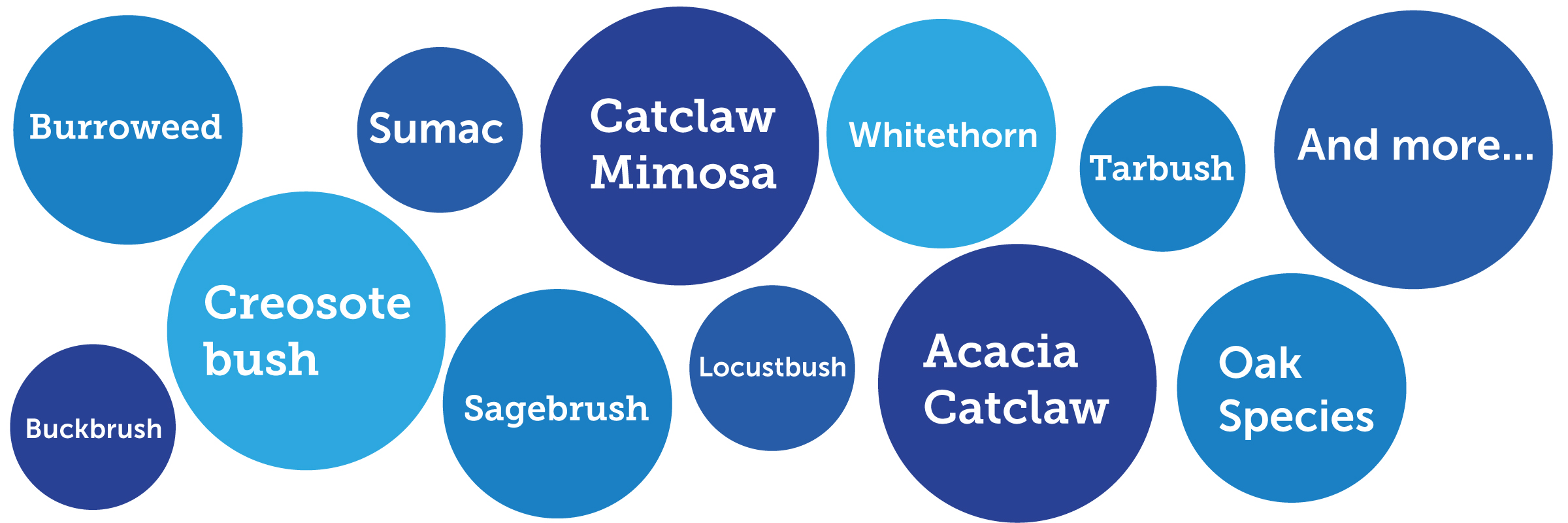
(Depending on soil type, plant species, etc. Rates vary)
Application methods
Most large-scale successful projects are done and have been done aerially with a fixed-wing aircraft. However, we have been a part of jobs done by helicopter. Rates vary but range from 3.75 lbs to 10 lbs. of pellets per acre. This is by far the most consistent way to broadcast spread the herbicide pellets per acre. We have seen people use hand blowers to target individual plants and are currently working on a way to do this efficiently. Hand spreading is done regularly; however, more product than needed is generally used, rendering this method inefficient. We recommend hand spreading if you are doing short fence line runs, around corrals, or just a few plants here and there. On flat ground and at higher per-acre rates, we have some experience using a ground spreader. This method can be used, but the ground and terrain need to be somewhat easy to travel in a tractor or side by side, and the rate needs to be higher as the calibration can only put out about 10 lbs. per acre or more of pellets.
We commonly have aerial applicators we work with who are willing to make large acreage applications, and we, of course, can buy some pellets to spread around ourselves if our ambition allows. A new form of application in our industry is making its presence known and seems to have some initial success. Drone application is becoming increasingly common; however, we only see a couple of people who have worked to properly calibrate Tebuthiuron pellet spreading with a drone. This type of pellet spreading isn’t just about putting a certain number of pellets on the ground per acre; it also needs to have the correct distribution pattern. We are seeing favorable results about a year into this, and the applicator is learning a lot. Having an efficient application method of this herbicide that can be used on smaller scales will be crucial in the future of controlling invasive brush. The timing on all Tebuthiuron applications can vary, but it is generally recommended to apply before a slow, gradual rain or snowfall event rather than a dramatic rainfall event. This is why we usually recommend spreading in the fall or winter when gradual rain or slow snow is most likely.
Lessons learned
In conclusion, tebuthiuron or Spike 20P herbicide application has been used for years with great success to thin out invasive brush species on the rangeland. With limited application techniques on smaller acreage, it’s nice to be able to “teach an old dog new tricks” and welcome drone application technology into our choice of effective application methods.
This article was written by:
Tyler Bowen
Range and Pasture Sales Manager
PCA
 Azelis A&ES has experienced representatives that can help you make the right decision for your land management objectives. We are ready to provide you with a safe and effective solution.