
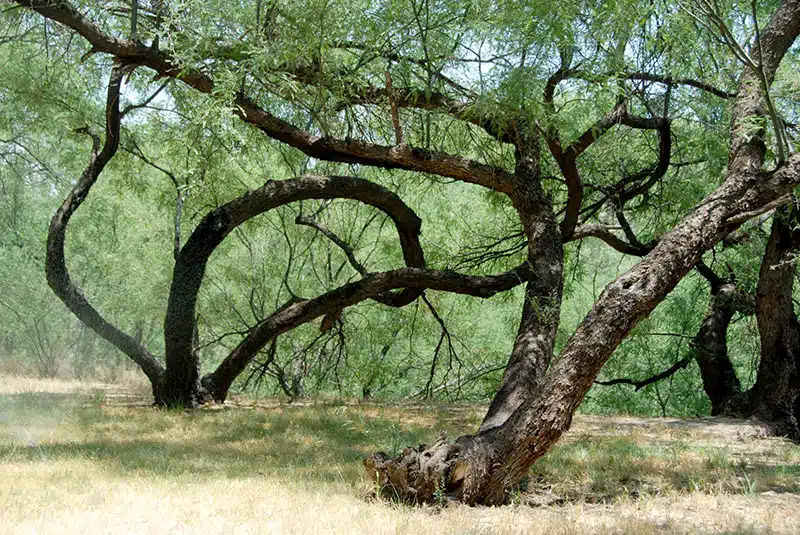

The debate on how, where, when, and who is responsible for mesquite taking over our grasslands is one with many different opinions in the southwest. No matter what your opinion is, you can likely agree that the mesquite density is greater than it once was. More information on the history of mesquite trees:
In this article, we will focus less on the history of or reasons why you would want to control mesquite, and more on the technical spraying of mesquite. Below, we will talk about the timing of mesquite spraying, as well as the options you may want to consider for mesquite spraying.
Typical mesquite spray timing

- Soil moisture: Good soil moisture prior to spraying is important. In Arizona, and New Mexico you need to have at least a few inches of precipitation in the first 6 months of the year prior to spraying, or else the mesquite will not be in good enough condition to spray.
- Soil temperature: At 12–18 inches in depth the soil should be between 75ﹾ and 86ﹾ F. This should be checked regularly as the temperature can be lower depending on how much moisture it has received.
- Mesquite condition: The way most of the herbicides work to control mesquite, they need to be translocated down to the plant’s roots. These herbicides will flow with the plant’s carbohydrates to the roots. A mesquite tree will look one of two ways when it is ideal.
Early Season
Early in the season (May/June) it will be putting off yellow flowers and have a dark green healthy leaf, if the soil temperature and other factors check off you can spray.
Second timing
The second timing (July/August) is after the beans have fully elongated and the mesquite has a good quality, full dark green leaf. In rare occasions after a good monsoon, you can spray mesquite later when it is full of leaf and dark green.
-
Watch outs: Remember you want the mesquite healthy appearing and sending its carbohydrates down to its roots. If there is insect damage, hail damage, disease, or light green unhealthy-looking leaves, do not spray.
-
Application: Proper rates, and adjuvants are required from product labels. Air temperature must be lower than 90ﹾ F. Winds must be between 2-10 MPH. Rain events may change timing and call for monitoring closer.
What are your options?
When it comes to options, we have a good amount to choose from. You just have to know if you will be doing a broadcast spray or doing the treatment by hand.
Broadcast spray options:
- LandVisor™: This is a technology coupled with proven herbicides by Corteva Agriscience. It is available in Texas and New Mexico and is backed by a guarantee. Depending on where you are if you do not have 75% control or better 2 years after application the manufacturer will retreat. The manufacturer will monitor and make the call on application timing via satellite imagery.
- Invora® and RangeView™: Here is a newer chemistry in the mesquite control market labeled for certain lands in the Southwest, rates vary depending on location. Invora also is backed by a guarantee, and said to be retreated for free if there isn’t a significant canopy reduction five years after treatment.
- Sendero®: Stand alone product for mesquite control in Texas on honey mesquite.
- Sendero® + Remedy® Ultra: Standard in New Mexico for control of mesquite, rates vary depending on location and state.
- Sendero® + Tordon®: Another good option for mesquite and mixed brush control in Arizona and New Mexico. Tordon has added benefits with more species. Rates vary depending on location.
- Sendero® + Surmount®: This option is mainly used in northern New Mexico to target applications with cactus and other brush.
Hand treatment options:
- Invora®: New chemistry in the mesquite control market labeled for certain lands in the Southwest, rates vary depending on location. Timing would be typical mesquite spray timing.
- Sendero® + Remedy® Ultra: Standard in New Mexico for control of mesquite, rates vary depending on location and state. Timing would be typical mesquite spray timing.
- Remedy® Ultra + Basal Oil: This is more of a stem treatment for small diameter mesquite trees. Timing is more flexible.
- Velpar L: This is an option you must be very deliberate as to where you apply. Timing is just before light rainfall.
AAA: Always Add Adjuvants
Adjuvants are substances added to herbicides to improve their effectiveness, either by enhancing the absorption of the herbicide into the plant or by improving the overall performance of the herbicide. Three that we typically recommend when it comes to mesquite are:
- Elite Pinnacle
- Elite Velocity
- RRSI 90
There are several options when it comes to controlling mesquite using chemicals. Finding the one that is best for you is what we can assist in. Based on your goals and expectations, we are sure there is an option to help you reclaim your grassland.
 Azelis A&ES has experienced representatives that can help you make the right decision for your land management objectives. We are ready to provide you with a safe and effective solution.